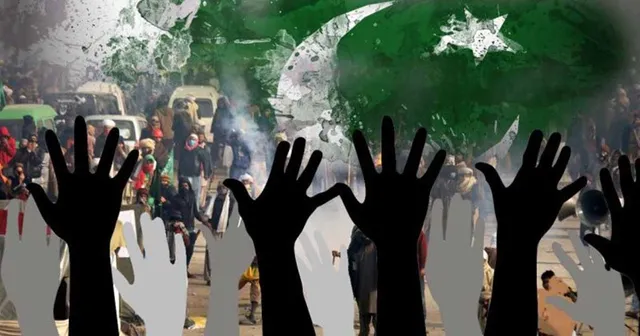


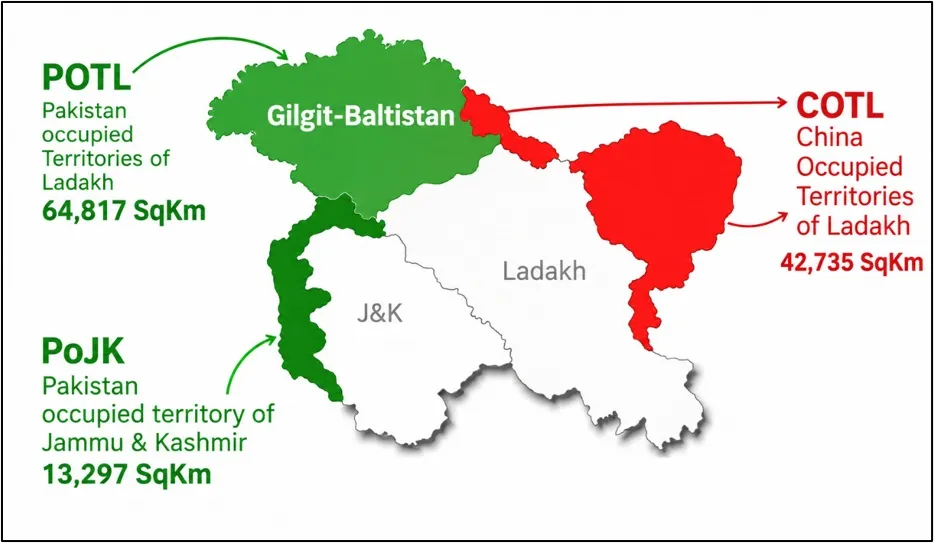
Since 1947, Pakistan has built much of its position on Kashmir around the principles of self-determination, democracy and human rights. Yet its administration of Gilgit-Baltistan and Pakistan-administered Jammu & Kashmir presents a more complicated picture, marked by constitutional ambiguity, limited representation, disputes over land and resources, and recurring protests.
The contrast raises a question that sits at the heart of Pakistan’s Kashmir narrative: if Kashmiris must be given the right to determine their political future, why has Islamabad not extended the same principle fully to people living under its own administration?
The roots of the dispute go back well before Pakistan was created. In 1846, following the First Anglo-Sikh War, the British transferred Kashmir and associated territories to Maharaja Gulab Singh under the Treaty of Amritsar. The arrangement was concluded between political authorities rather than through a process of popular consent.
The political order changed dramatically a century later. On November 1, 1947, the Gilgit Scouts revolted against Dogra authority, after which Pakistan established control over Gilgit-Baltistan. The territory did not, however, become a fully integrated province of Pakistan. Instead, it was placed under a special administrative system in which decision-making remained heavily dependent on authorities outside the region.
The Karachi Agreement of 1949 further consolidated that arrangement. Administrative responsibility for the Northern Areas was transferred to Pakistan’s federal government. Gilgit-Baltistan itself was not represented in the agreement, reinforcing a system in which major decisions concerning the territory were taken without a directly elected local voice.
For decades, Gilgit-Baltistan remained outside Pakistan’s conventional constitutional structure. Islamabad administered the territory through special legal and executive arrangements rather than the constitutional framework governing Pakistan’s provinces.
Reforms introduced through the 2009 Empowerment and Self-Governance Order and the 2018 Government Order created elected institutions and expanded certain local powers. They did not, however, settle the territory’s constitutional status. Gilgit-Baltistan still does not have representation in Pakistan’s National Assembly or Senate and has not been granted full provincial status.
That unresolved position has become increasingly difficult to separate from the territory’s strategic importance.
Gilgit-Baltistan contains extensive mountain, river, glacier and forest systems and is also home to mineral resources. Its location makes it particularly important to the China-Pakistan Economic Corridor, giving the region significance for both Islamabad and Beijing.
Local concerns have centred on land acquisition, mining, resource management and the extent to which residents participate in decisions affecting development. Roads, energy projects and tourism can bring economic opportunities, but disputes increasingly focus on who controls such projects and how their benefits are distributed.
Those tensions have periodically spilled into the streets.
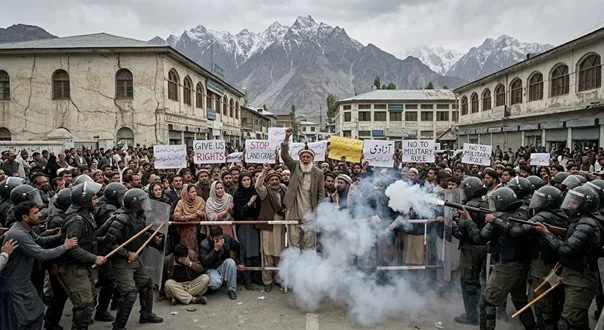
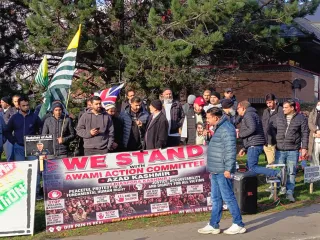
The Gilgit-Baltistan Awami Action Committee has mobilised residents over issues including wheat prices, electricity, taxation, healthcare, education and political rights. The use of anti-terrorism provisions against activists has also prompted criticism that economic and political grievances are sometimes approached through a security lens rather than treated as matters of public policy.
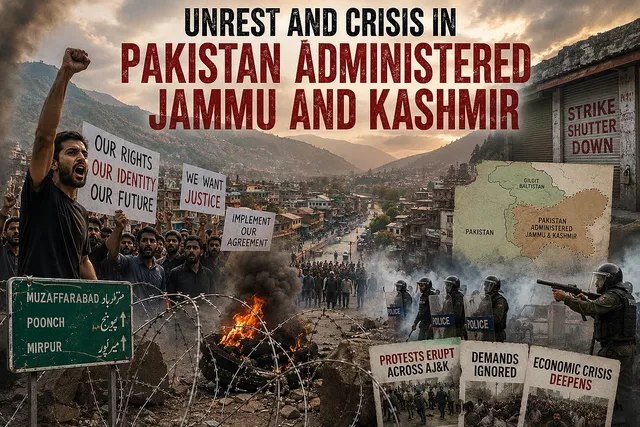
Comparable tensions have emerged in Pakistan-administered Jammu & Kashmir.
Residents have protested over electricity tariffs, taxation, shortages, resource distribution and the rising cost of living. Disputes over natural resources and economic policy have been accompanied by demands for greater transparency and local accountability. Crackdowns on protest movements have further fuelled concerns about the space available for political expression.
The grievances in the two territories are not identical, and their constitutional and administrative arrangements differ. But together they challenge the simplicity of Pakistan’s international presentation of the Kashmir question.
Islamabad has repeatedly argued that the unresolved status of Kashmir prevents permanent constitutional integration of territories such as Gilgit-Baltistan. That argument creates a dilemma of its own: an international dispute that has remained unresolved for decades also leaves residents without a settled constitutional relationship with the state exercising administrative control over them.
For India, the contrast has an obvious geopolitical dimension. New Delhi has increasingly presented development, connectivity and tourism in Jammu & Kashmir as evidence of deeper economic and institutional integration. Pakistan, meanwhile, continues to argue internationally that Kashmiris should determine their own political future.
The competing narratives therefore extend beyond the Line of Control.
Pakistan’s challenge is not simply to defend its position on Kashmir internationally. It is also to reconcile that position with governance in the territories it administers. Calls for self-determination carry greater political force when they are accompanied by meaningful representation, accountable institutions and space for dissent at home.
Development alone cannot resolve that contradiction. New infrastructure or economic investment does not answer the underlying questions of political representation, constitutional status and control over land and resources.
For the people of Gilgit-Baltistan and Pakistan-administered Jammu & Kashmir, those questions remain central to their relationship with Islamabad.
The historical record has left both territories with political arrangements shaped by decisions taken largely outside them. Decades later, demands for greater representation and local control continue to test the limits of those arrangements.
Pakistan’s Kashmir narrative is therefore confronted by a question that cannot be answered solely at international forums: how much self-determination is Islamabad prepared to accommodate for the Kashmiris living under its own administration?