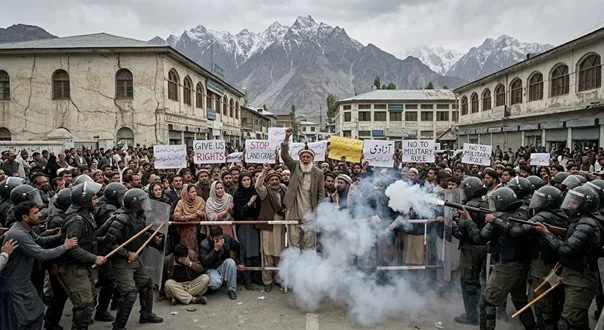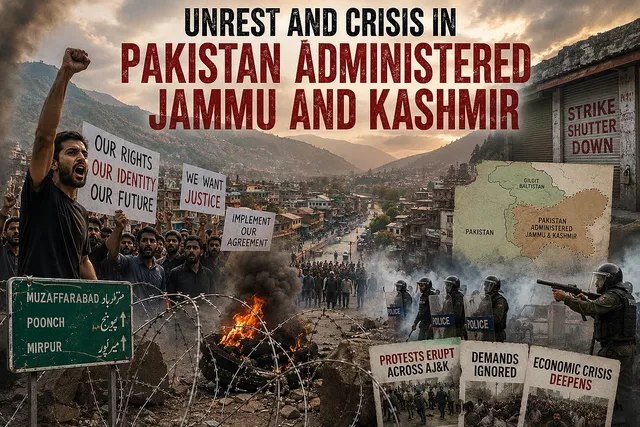
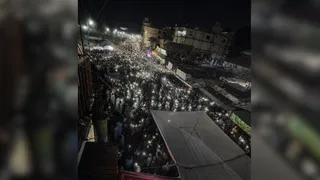

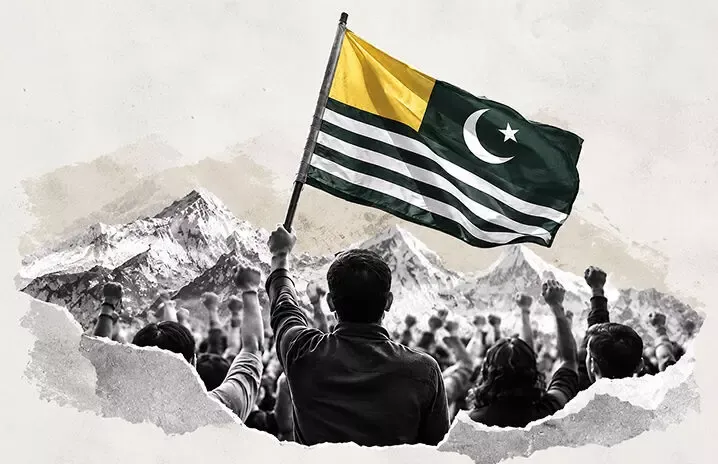
Pakistan-occupied Jammu and Kashmir (PoJK) is entering another period of mounting political and social uncertainty. What began as a series of public grievances over economic hardship, governance and basic rights has increasingly evolved into a wider crisis of trust between citizens and the authorities.
The growing unrest reflects more than dissatisfaction with individual policies. It points to deeper concerns over political representation, institutional accountability and the credibility of the electoral process.
From Economic Grievances to Political Anger
For years, people across PoJK have raised concerns about electricity shortages, high prices, flour availability, unemployment and the rising cost of living. These economic pressures have become closely intertwined with broader political demands.
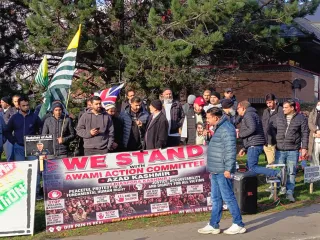
The repeated protests in places such as Rawalakot, Muzaffarabad, Mirpur and Kotli demonstrate how local grievances can rapidly acquire a region-wide character.
The central problem is that economic demands are increasingly being interpreted through the lens of political exclusion. When citizens believe that institutions are unwilling or unable to respond to legitimate demands, demonstrations can move beyond individual issues and become expressions of wider dissatisfaction with the system itself.
Electoral Distrust Is Deepening the Crisis
A functioning political system depends not only on elections being held but also on public confidence that elections provide a meaningful route to representation.
In PoJK, persistent questions surrounding political influence, institutional interference and the ability of elected representatives to act independently have contributed to growing electoral distrust.
When voters begin to believe that political outcomes are predetermined or that elected governments have limited room to make independent decisions, elections lose their ability to serve as a pressure-release mechanism.
That creates a dangerous vacuum.
Instead of resolving disputes through legislatures, courts and elections, people increasingly turn to streets and protest movements to make their voices heard.
Protest Is Becoming More Confrontational
Recent mobilisation has shown the expanding capacity of civil-society and rights-based groups to coordinate demonstrations across different parts of PoJK. Calls for wheel-jams, shutdowns and demonstrations have brought together communities around common demands.
The danger lies in what happens when peaceful mobilisation encounters a heavy-handed response.
A cycle can quickly develop:
Public grievance → protest → state restrictions → confrontation → wider mobilisation → deeper distrust.
Once such a cycle takes hold, even relatively limited disputes can trigger larger political instability.
The authorities therefore face a choice. They can treat public mobilisation primarily as a security problem, or they can recognise it as an indicator of institutional and political failure requiring dialogue.
The Information Gap Makes Matters Worse
Restrictions on communications during periods of unrest can further intensify public suspicion.
When internet access or information flows are disrupted, rumours can spread faster than verified information. Families struggle to communicate, journalists face difficulties reporting developments, and authorities lose an important channel for explaining their actions.
Information restrictions may temporarily reduce the visibility of protests, but they do not necessarily remove the grievances driving them.
In many cases, they can deepen perceptions that authorities are attempting to suppress rather than address public concerns.
A Wider Crisis of Representation
The PoJK crisis also raises fundamental questions about political agency.
Citizens expect elected institutions to represent local priorities and provide mechanisms through which grievances can be addressed. When political institutions appear disconnected from public demands, legitimacy begins to erode.
This is particularly significant in a region where questions surrounding political rights and representation have remained contentious for decades.
The current unrest should therefore not be viewed solely through the prism of law and order. It is also a governance challenge.
Suppressing symptoms without addressing underlying grievances risks pushing dissatisfaction into more unpredictable forms.
Why the Current Moment Matters
The convergence of economic pressure, political dissatisfaction, electoral distrust and increasingly confrontational protests creates a particularly fragile environment.
Each issue reinforces the others.
Economic hardship increases anger. Political exclusion makes that anger harder to channel through institutions. Electoral distrust weakens faith in democratic mechanisms. Restrictions during protests can intensify suspicion. Confrontation then creates further instability.
This is how isolated grievances can become a systemic crisis.
The immediate priority should therefore be de-escalation.
Authorities need to create credible channels for dialogue, ensure that peaceful protest is treated as a legitimate form of public expression, restore confidence in electoral institutions and address concrete economic concerns.
At the same time, political actors and protest leaders have a responsibility to prevent demonstrations from turning violent and to ensure that legitimate public demands are not undermined by intimidation or destruction.
The Cost of Ignoring Public Trust
PoJK does not simply need another temporary settlement after another round of protests. It needs institutions capable of absorbing public dissatisfaction without allowing it to become a recurring confrontation.
The lesson from the present crisis is straightforward: political stability cannot be sustained by force when public trust is steadily declining.
If economic grievances remain unresolved, political participation remains constrained and electoral processes continue to face credibility questions, instability is likely to deepen.
The unfolding situation in PoJK is therefore a warning sign. The longer legitimate grievances remain unanswered, the harder it becomes to contain the political consequences.
What is at stake is not merely the outcome of one protest or one political dispute. It is the credibility of governance itself—and whether the people of PoJK believe their voices can still produce meaningful political change.