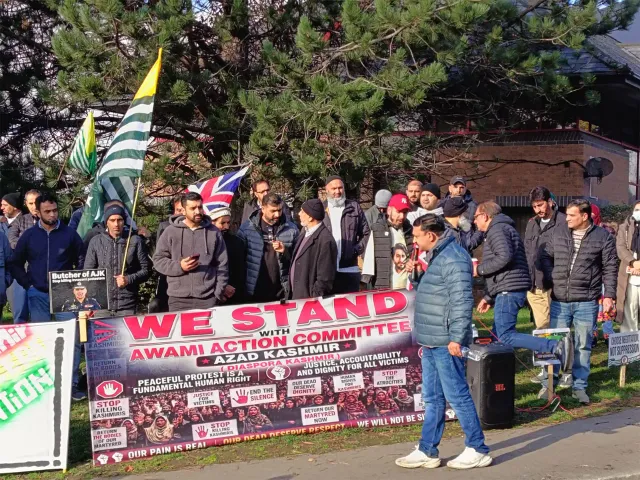



The Jammu Kashmir Joint Awami Action Committee (JKJAAC) has reiterated its call for the transfer of ownership, governance, and supreme authority to the people of Pakistan-occupied Jammu and Kashmir (PoJK), emphasizing that the region’s natural resources, land, and political future should be determined exclusively by its residents.
In a recent statement posted on X, the JKJAAC asserted that the rights of ownership, governance, and supreme authority are fundamental and inalienable rights of the people of PoJK, and should be transferred to them unconditionally.
The committee maintained that the people of PoJK should have exclusive authority over the region’s resources, land, natural wealth, political decisions, and future.
This demand, according to the JKJAAC, extends beyond the distribution of resources and is rooted in the struggle for self-determination, self-respect, and the right of the people to decide their own future.
The JKJAAC’s statement was accompanied by a discussion delivered by Kamran Beg at the Conference on the Right of Ownership and the Right of Governance, where he presented historical facts and logical arguments addressing the movement for people’s rights, the prevailing situation in PoJK, and the political and economic rights of its residents.
Beg’s discussion underscored the committee’s position that the people of PoJK have the first right over the region’s resources and that decisions concerning their future should rest with them.
This latest call from the JKJAAC underscores its demand for greater authority over the region’s political and economic affairs, with ownership of resources and the right to governance at the center of its push for people’s rights.
The committee’s efforts are part of a broader movement seeking to empower the people of PoJK in determining their own political and economic destiny, free from external control.
Earlier, the JKJAAC had accused the Pakistan government of creating conditions in PoJK similar to those in Balochistan and Khyber Pakhtunkhwa, alleging that the administration’s handling of protests and dissent could fuel further unrest in the region.
In a post attributed to Qaiser Khan, the JKJAAC questioned whether the government’s actions were pushing people towards militancy, drawing comparisons between the security situations in Balochistan, Khyber Pakhtunkhwa, and PoJK.
The JKJAAC’s demands and criticisms come at a time of heightened sensitivity regarding the governance and rights of the people in PoJK.
The committee’s emphasis on self-determination and the right to governance reflects deeper concerns about the political and economic future of the region and its people.
As the situation in PoJK continues to evolve, the JKJAAC’s calls for the transfer of ownership and governance rights to the people of the region are likely to remain a central point of discussion and contention.
In the context of the region’s complex political landscape, the JKJAAC’s demands are seen as part of a larger narrative about the rights and autonomy of the people of PoJK.
The committee’s persistence in highlighting these issues underscores the ongoing struggle for self-determination and governance rights in the region.
The international community and regional stakeholders are watching the developments in PoJK closely, as the situation has implications for stability and human rights in the area.
The JKJAAC’s statement and the discussion by Kamran Beg at the conference serve as a reminder of the deep-seated desire among the people of PoJK for greater control over their political and economic affairs.
The call for the transfer of ownership and governance rights is not merely a demand for resource distribution but a fundamental plea for the recognition of the people’s right to decide their own future.
This plea is set against the backdrop of historical and ongoing struggles in the region, where questions of governance, autonomy, and self-determination have been central to the political discourse.
As the JKJAAC continues to advocate for the rights of the people of PoJK, its efforts are likely to contribute to the ongoing debate about the region’s future.
The committee’s demands for greater autonomy and self-governance reflect a broader aspiration among the people of PoJK for a more inclusive and participatory political process.
The realization of these demands would require significant shifts in the current governance structures and a willingness among all stakeholders to engage in meaningful dialogue about the region’s political and economic future.
In conclusion, the JKJAAC’s call for the transfer of governance and ownership rights to the people of PoJK highlights the complex and sensitive nature of the region’s political landscape.
The committee’s efforts to empower the people of PoJK and to secure their rights to self-determination and governance are part of a larger struggle for autonomy and human rights in the region.
As the situation in PoJK continues to unfold, the international community and regional stakeholders will be closely watching the developments, recognizing the significance of the JKJAAC’s demands for the future of the region and its people.